


| File Reference : | GG-7-07 Working Safely at Height |
| Date File Updated | 07-10-26 |
| Category | General Guidance | Tags: ISO 45001, 6.1, 7.2, 8.1, 8.2 |
Included in the alphaZ subscription
Every alphaZ document and toolkit, with updates as they are released. Everything you download is yours to keep.
You are logged in as an alphaZ subscriber
This document's file is ready to download from the Download Files tab below.
This guidance covers avoiding, preventing and limiting falls, ladders, fragile roofs, and the checks and rescue planning expected of everyone who works at height.
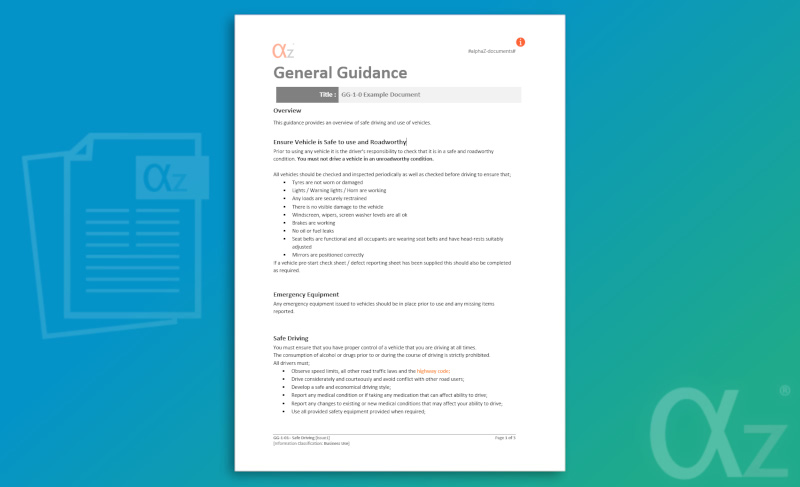
This guidance document is supplied in fully editable MS Word format and can be easily customised and edited. The document uses pre-defined style formatting throughout, with all text in Calibri font for improved readability.
The following document labelling is included in the footer:
- Guidance number and title
- Information-classification
- Version
- Page number / total pages

Further guidance on working at height:
These files are included in the alphaZ subscription. The training talk is also included in the ISO 45001 Toolkit and the integrated toolkits that include it.

If you'd like hands-on help planning work at height and preparing the risk assessments behind it, our remote support services provide direct expert input from our team, by the day, by project, or on an ongoing basis.

Working Safely at Height Guidance
A general guidance document on working safely at height, for workers who may work at height and the people who plan that work. It explains what counts as working at height, how the company avoids, prevents and limits falls, the common causes of fall accidents and what workers must do.
Topics Covered
- What working at height means - anywhere a fall could cause injury without precautions, such as a ladder, a flat roof, a fragile surface or a floor opening
- Avoiding and preventing falls - avoiding work at height where possible, then using a safe place of work or equipment such as a mobile elevating work platform
- Limiting the consequences - harnesses, safety nets and soft-landing systems where a risk of falling remains, and protecting others from falling objects
- Ladders and training - ladders for low-risk, short-duration tasks, the right ladder for the job, risk assessed work and training for everyone involved
- Common causes of accidents - where fall accidents commonly happen, such as roof repairs and cleaning, and which roof materials are likely to be fragile
- Worker responsibilities - working from the ground where possible, checking the place of work, weather, exclusion zones, safe storage and rescue planning
Who Is It For?
Anyone who works at height, including on ladders, roofs or work platforms, and the managers and supervisors who plan and organise that work.
Included in the ISO 45001 Toolkit
This guidance is supplied with the TT-7-07 Working Safely at Height training talk, which is part of the ISO 45001 Toolkit and the integrated toolkits that include it.
Using the Guidance
Issue it before anyone is given work at height, and go through it again before roof work. Record who has received it, for example on the training matrix.
Avoid, Prevent, Then Limit a Fall
The guidance sets out the company's approach in order. Work at height is avoided wherever possible. Where it cannot be, falls are prevented by using an existing safe place of work or equipment such as a mobile elevating work platform. If a risk of falling remains, harnesses, safety nets or soft-landing systems limit the distance and consequences. Ladders may be used for low-risk, short-duration tasks.
Adapting the Guidance
Edit the guidance to match your own arrangements - the access equipment you use, when ladders are allowed, how work at height is risk assessed and your emergency, evacuation and rescue procedures.
Related Documents
Other documents that work alongside this guidance:
- PP-7-07 Working Safely at Height Policy Procedure
- P-76 Working at Height Policy
- RA-HS01 Working at Height
- F-HS39 Scaffold Inspection Checklist
- GG-7-21 Safe Use of Ladders
Would you rather we prepared it for you?
A day of remote support can take the risk assessments you already have, move them into one consistent format with the same scoring throughout, and build your hazard register from them, so the hazards this guidance covers are backed by a current assessment.
These files are for alphaZ subscribers. Log in to the subscriber library once and each file below downloads straight away. Not a subscriber yet? See the alphaZ subscription.
Each file downloads straight away. You can also browse the subscriber library.
- GG-7-07 Working Safely at Height Word, 46 KB
